
Best Public Housing Authority Software: A 2026 Buyer's Guide
What is the best public housing authority software?
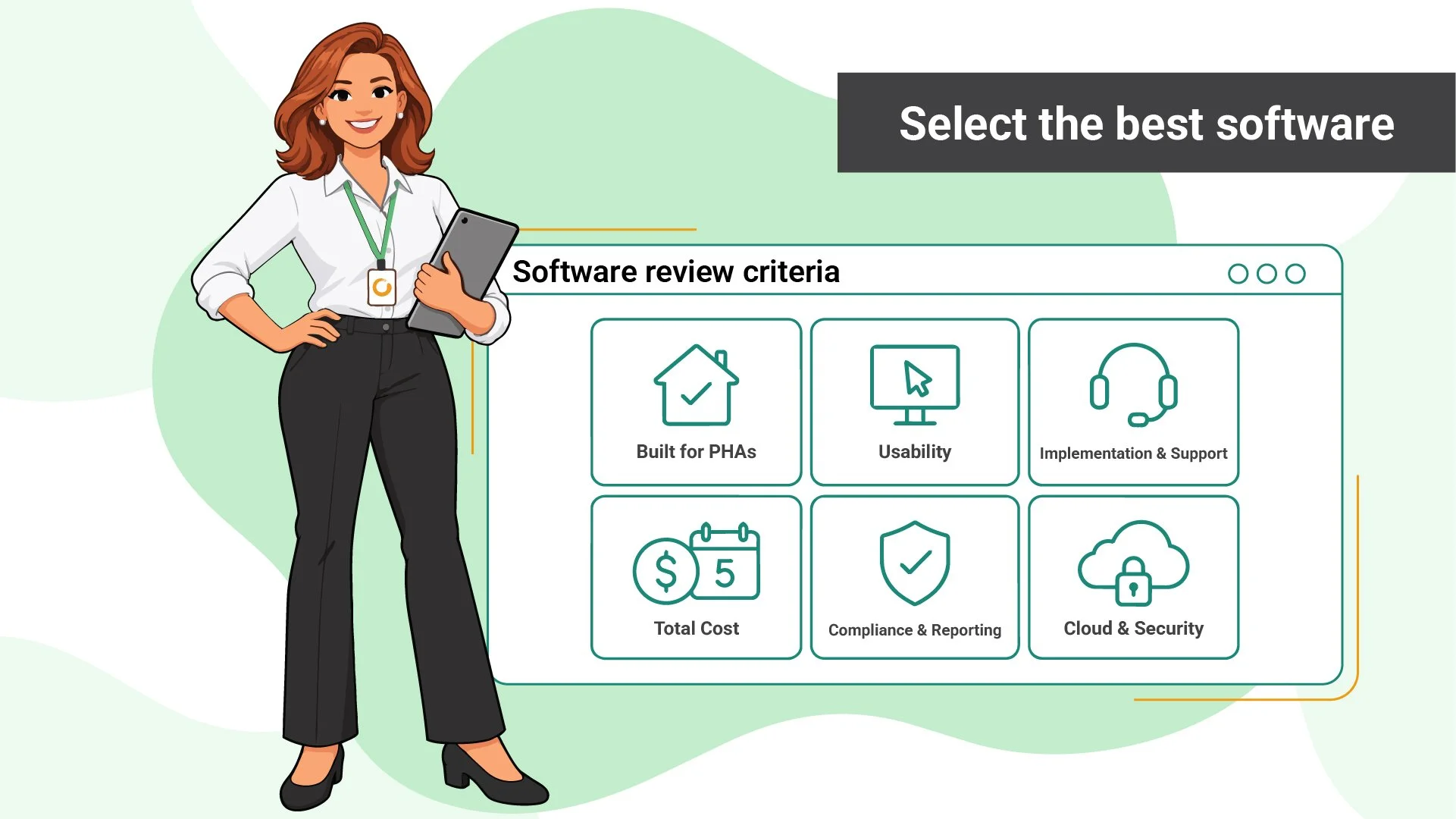
The best public housing authority software is the one that is built for your HUD programs, that your staff can learn quickly, and that you can afford over the long run, not just in year one. Judge every option on six things: fit for PHAs, usability, implementation and support, total cost of ownership, compliance and reporting, and cloud security. Because “best” depends on your agency’s size, programs, and team, this guide shows you how to compare public housing software vendors rather than handing you a ranking.
What “best” really means for a housing authority
Search for the best housing authority software, and you will find plenty of top-10 lists. They are a useful starting point, but they can’t tell you whether a system fits the HUD work a small or mid-size authority does every day.
You also rarely make this decision, often only once every several years, so a poor fit means years of workarounds. For a housing authority, best means best fit: your programs, your unit count, your staff’s comfort with technology, and your budget. Six criteria decide that fit.
Six criteria that separate the options
Score every vendor against these six criteria, and give the most weight to the ones that matter most to your agency.
1. Fit for PHAs specifically
Purpose-built software handles HUD workflows natively: the Form HUD-50058, PIC/IMS submissions, housing assistance payments (HAP), EIV, recertifications, and inspections. A general property management suite with an added PHA module often makes you bend your process to fit it. For every workflow, ask whether it is native, a supported integration, or a workaround.
2. Usability and a modern experience
Ordinary staff should be able to learn the system quickly and move through routine tasks without extra steps. Public housing teams see real turnover, so a system that takes months to learn is a recurring cost, not a one-time one. Even an easy system needs a safety net: fast, friendly support when someone gets stuck, and trainers who can get a new hire up to speed quickly when you need them. Ask how long until a new caseworker is productive in the system, and what training and support the vendor offers along the way.
3. Implementation and support
Going live means converting your data, configuring the system, and training your team. After launch, you need real people who answer quickly and keep training new staff as they join. Ask who supports you after go-live, and how fast they respond.
4. Total cost of ownership
The license fee is only part of the price. Compare the all-in cost over five years, including implementation, data conversion, training, add-on modules, support tiers, and annual increases. Count staff time too, since a slow system costs hours every week. Ask which features are included in which package.
5. Compliance and reporting confidence
Look for software that checks 50058 data for errors before it goes to HUD and produces reporting that shows your compliance. Accurate 50058 data feeds several SEMAP indicators, and accurate financial data feeds your PHAS score. Our guide to PHA compliance software covers this in more depth.
6. Cloud, security, and continuity
True cloud software lets staff log in securely from anywhere, with no office server to patch and back up. Ask about security audits, backups, uptime, and the vendor’s stability, and ask whether the product is true cloud or older server software hosted elsewhere. Our cloud and SaaS guide explains the difference.
Some workflows deserve a closer look of their own. See our guides to public housing maintenance software, tenant portals and waitlists, and what executive directors should look for.
The three types of public housing software vendors
Public housing software providers fall into three broad types. Each has real strengths, and each fits some agencies better than others. A strong shortlist usually includes more than one type. Whatever the type, ask for references at agencies your size.
Purpose-built PHA vendors
These vendors focus on housing authorities and HUD programs. Some are newer cloud platforms, and others have decades of experience in public housing and are at different points in moving to the cloud. They tend to suit agencies that want a vendor who knows HUD work and a system sized for their team. Because the group varies so much, look past the label: confirm each HUD workflow in a live demo, ask what "cloud" means for their product, and ask where the product is headed.
Enterprise real-estate suites with a PHA module
These large property platforms serve housing authorities alongside other markets. They tend to suit mixed-portfolio agencies that want one vendor for everything, including tax-credit or market-rate properties. Watch for HUD workflows that feel adapted and support queues built for much larger clients.
General property management tools
This software is built for landlords and market-rate multifamily. Some general tools advertise HUD compliance, but that usually means HUD's multifamily programs, which use the HUD-50059 and the TRACS system. Housing authorities work in a different system: the Form HUD-50058, submitted through PIC, along with public housing and voucher workflows like housing assistance payments to landlords and waitlist preferences. That is why general tools are rarely the right core system for a PHA. They can still work for an agency's non-HUD or tax-credit properties.
Buyer tip: When a vendor says "HUD compliant," ask which program and which form: 50058 or 50059.
How to read public housing software reviews
The most useful review is a reference call. Ask each vendor for two or three agencies, then ask those agencies what implementation was really like and how support has held up since.
Review sites and peer networks, including NAHRO and Housing Heroes Hub, can add context. Read them with your agency in mind and give the most weight to recent comments about support and go-live.
A five-step way to compare public housing software
Use this process to compare vendors on equal terms:
Profile your agency. Note your units, programs, staff, budget, and timeline.
Weight the six criteria. Decide what matters most for an agency like yours.
Build a shortlist. Pick three to five vendors, drawn from more than one vendor type.
Run scripted demos. Give every vendor the same real scenarios, such as an interim recertification or a 50058 error, so you compare like with like.
Score and verify. Rate each vendor, check references, and compare five-year cost before you sign.
The bottom line
The best public housing authority software is the one that fits your agency, judged on six criteria and on what it will cost over five years. For the full category view, read our complete guide to public housing authority software, and when you are ready, schedule a demo.
Frequently Asked Questions (FAQs)
-
There is no single best option for every agency. The best fit is purpose-built for HUD programs, easy for your staff to learn, well supported after launch, and affordable over five years. Compare vendors on fit, usability, support, total cost, compliance, and cloud security.
-
Public housing software vendors fall into three types: purpose-built PHA vendors, enterprise real-estate suites with a PHA module, and general property management tools. A strong shortlist usually draws from more than one type.
-
Weight six criteria for your agency, run scripted demos using the same real scenarios with every vendor, check references at agencies your size, and compare the five-year total cost before you sign.
-
Usually not as a core system. General property management tools are built for market-rate rentals. When they claim HUD compliance, it is usually for HUD multifamily properties (the HUD-50059), not the Form HUD-50058 that housing authorities submit for public housing and vouchers.
-
For most agencies, yes. True cloud software removes the office server and gives staff secure access from anywhere. Confirm the product is true cloud and not older server software hosted elsewhere.
