
Public Housing Software: Tenant Portal and Waitlist Management
What is public housing software with a tenant portal?
Public housing software with a tenant portal lets residents make payments, submit documents, and request repairs online, while waitlist management handles applications, preferences, and selection. Together they move routine work off the front desk and keep applicant and occupancy records on one HUD-focused system, so the authority runs both sides from a single source of truth.
Two features, one system: the portal and the waitlist
For a housing authority, two of the busiest doors are the ones the public uses. Residents call and visit to ask about balances, payments, and repairs. Applicants call and visit to get on a waiting list and to check where they stand. Public housing software answers both through two connected features: a resident-facing tenant portal for self-service, and applicant-facing waitlist management for intake and selection.
What makes them useful is not that they exist, but that they sit on the same system that runs the rest of the authority. What a resident does in the portal and where an applicant sits on the waiting list both tie back to occupancy and the Form HUD-50058 record, rather than living in a separate tool someone has to reconcile. For the full category picture, see our complete guide to public housing authority software.
The tenant portal: self-service that lifts front-desk load
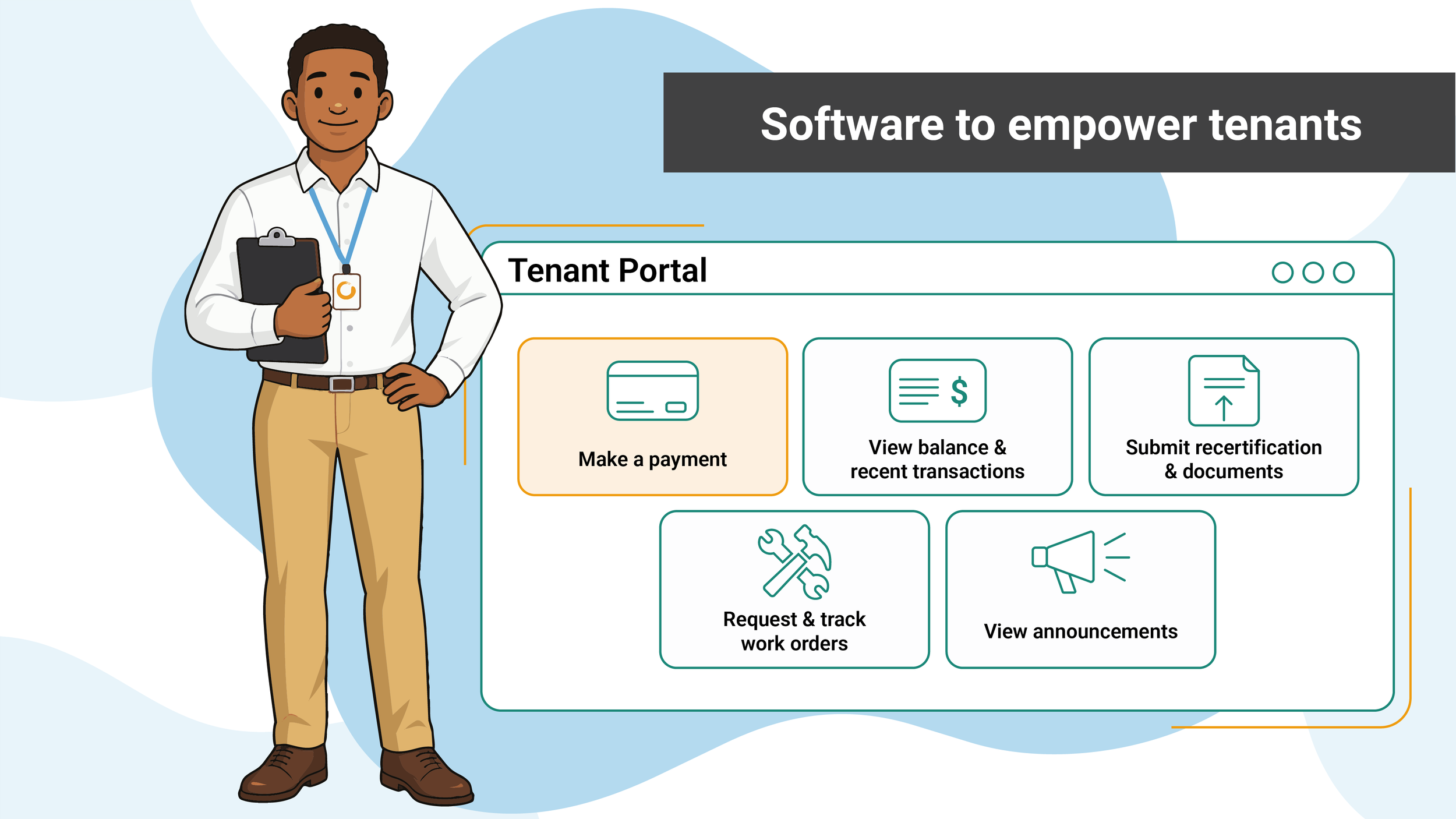
The tenant portal is where residents handle routine business without calling or coming in. From a web browser, a resident can make a payment, view account balances and recent transactions, submit annual recertification information along with supporting documents, request a work order and track open and past repairs, and read announcements from the authority.
Every one of those actions lands in, or connects to, the authority's system, so staff stop re-keying paper forms and returning voicemails. The result for the office is fewer walk-ins and phone calls, faster document collection, and a cleaner record of who asked for what and when. The result for residents is that a payment or a question does not depend on office hours.
The recertification piece is worth calling out. When a household submits its annual certification details and uploads verification online instead of in person, the authority collects cleaner information sooner and spends less time chasing paperwork. The regulatory detail behind recertification is a compliance subject in its own right, covered on the compliance page.
Waitlist management: from application to eligible applicant
The waiting list is the other public-facing workflow, and it carries real fair-housing weight. Good software runs the whole lifecycle online: applicants apply through a web form, the authority opens and closes the list on a schedule or by applicant count, eligibility and preference criteria rank the list, and applicants can check their status while the list is open.
Running it online also builds in the safeguards a spreadsheet cannot. The system screens for duplicate registrants, lets applicants update or withdraw their own registration while registration is open, and keeps a backed-up record for any post-selection audit. That means selection is consistent and documented, which is exactly what an authority wants to be able to show. Deeper preference and selection rules belong on the compliance page. Here the point is that the list is fair, online, and auditable.
Where the two meet: filling a ready unit
The payoff shows up when a unit is ready to lease. Once selection places applicants on the waiting list, the authority works from that established list to fill units as they become available, rather than starting a search from scratch each time.
Because the waitlist and occupancy share the same records, a ready unit gets matched to the next eligible household without staff reconciling two disconnected tools. Every day a unit sits empty is a day of lost rent and one more household waiting, so the speed of that match matters to the whole authority, not just the leasing desk. Keeping intake, selection, and occupancy on one system is what keeps ready units from sitting idle.
Purpose-built for PHAs vs. a generic tenant portal
This is the distinction that matters most when an authority compares options. Plenty of property management tools offer a resident portal and an application form. What they do not understand is HUD. A generic portal can take a payment, but it has no concept of a recertification, a voucher, or an occupancy status tied to a federal program, and a generic application form does not know a housing authority's preference rules.
Purpose-built PHA software takes the opposite approach. The portal and the waitlist run on the same platform as 50058, HCV, public housing, and the authority's other programs, so a payment, an application, and a household record all understand each other. The data is one system, not two that someone has to stitch together. That is the same argument the pillar guide makes for the category as a whole, and you can see what purpose-built looks like on Kanso's public and affordable housing platform. When you are ready to compare options or see it in action, a demo is the fastest way to judge the fit for your authority.
Frequently Asked Questions (FAQs)
-
On a modern portal, residents make payments online, view account balances and recent transactions, submit recertification information and documents, request and track maintenance, and read announcements from the authority. Each action is recorded in or connected to the authority's system, so staff are not re-keying paper.
-
That is the key question. The difference is whether the portal connects to recertification, occupancy, and the 50058 record, or simply takes a payment. HUD-context integration is what separates purpose-built PHA software from a generic tool with a housing label.
-
It runs the waiting list online: application intake, opening and closing the list, eligibility and preference criteria that rank the list, applicant status tracking, duplicate screening, and applicant self-service updates. The result is selection that is consistent and documented rather than managed on a spreadsheet.
-
On one system, yes. The waitlist and occupancy share the same records, so as units become ready, the authority fills them from the established list without reconciling two tools. That connection is what reduces vacant days and keeps ready units from sitting idle.
-
Yes. Look for a web-based portal and online application that residents and applicants reach through a browser, so payments, submissions, and status checks happen online instead of at the front desk.
