
Cloud & SaaS Public Housing Software: What It Means for Your PHA
What is cloud public housing management software?
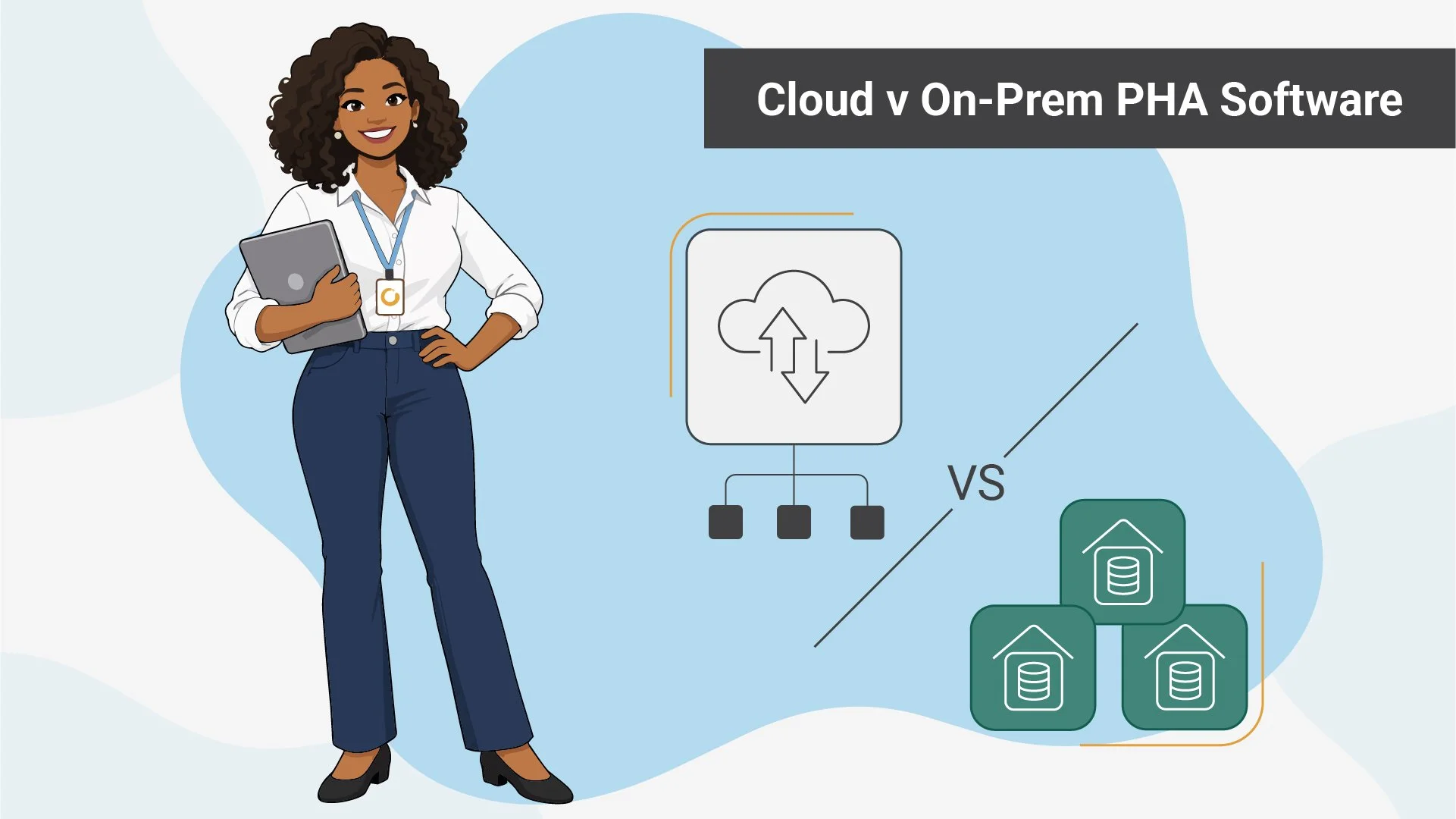
Cloud public housing management software is a HUD-focused platform that the vendor hosts, secures, and maintains, and that your team accesses through a web browser instead of a server in your office. The terms cloud-based, SaaS, web-based, and online all describe this same hosted delivery model.
Cloud vs. on-premise: what actually changes for a PHA
The core difference is who runs the servers.
On-premise software lives on hardware the housing authority owns, sitting in a closet or server room the agency has to power, patch, back up, and eventually replace. Cloud-based public housing software flips that arrangement. The vendor runs the infrastructure, and your staff signs in from any browser.
For a public housing authority, that shift changes daily work in a few concrete ways:
No local server to maintain. The vendor owns and runs the infrastructure, so there is no hardware for the agency to power, patch, and replace every few years.
Access through a browser, from any device. Staff sign in from any office, or from a unit in the field, without a VPN or a local install. Everyone works from one live system instead of synced copies.
One central copy of your data. Records live in the vendor's secured environment, not spread across machines in different offices.
Updates applied centrally. When HUD revises a rule, such as HOTMA income and asset rules or NSPIRE inspection standards, the vendor applies the change for every agency at once. No install disk, no version left behind.
For the full category picture, see our complete guide to public housing authority software.
Cloud, SaaS, web-based, online: are they the same thing?
For a housing authority buyer, yes. These terms all point to software the vendor hosts and you access over the internet. The technical shades between them rarely change the buying decision.
SaaS, short for software as a service, describes the subscription model: you pay to use the software rather than buying and installing it. Cloud-based and web-based describe how you get to it, through a browser rather than a desktop install. Online is simply the plain-language version of the same idea. Whether a vendor calls it SaaS public housing software, cloud-based public housing software, web-based housing authority software, or online housing authority software, the underlying model is the same.
It is worth being clear-eyed about one of these. A generation ago, web-based housing authority software was a selling point that set a vendor apart from installed desktop tools. Today it is the baseline. The useful question is no longer whether a platform is web-based, but how well it handles HUD programs and how securely it protects your data.
What a PHA gains by moving to the cloud
The payoff is less time spent maintaining software and more certainty that the system reflects current HUD rules.
Compliance certainty: Because updates are handled for you, the system reflects current HUD rules without an internal upgrade scramble, which lowers the risk of falling out of step at audit time.
Resilience: Off-site backups mean a fire, flood, or failed hard drive at the office does not put resident and program records at risk.
Field and multi-site productivity: Inspections and work orders happen on the same live system from any location, which speeds unit turns and cuts double entry. See how this plays out in our public housing maintenance software guide.
Predictable cost: A subscription replaces the boom-and-bust cycle of buying servers, licensing software, and refreshing hardware. Budgeting gets simpler and easier to defend to a board.
Faster onboarding: Staff turnover is a reality for PHAs. New hires reach a browser-based system from day one, with no local setup, which shortens the ramp when institutional knowledge walks out the door.
You can see these capabilities in practice on Kanso's public and affordable housing platform.
Security and compliance in the cloud
Moving resident and HUD data to the cloud does not mean giving up control of it. In practice, a reputable cloud platform is often more secure than an aging server in a PHA's back office, because security is the vendor's full-time job rather than an added duty for lean agency staff.
The questions a PHA should ask are concrete. Is data encrypted, both in transit and at rest? Who can access it, and how is that access controlled? How often is it backed up, and what happens if a system goes down? And has an independent party actually verified the vendor's security, or are you taking their word for it?
That last question is where certification matters. Kanso Software is SOC 2 Type 1 compliant, verified by an independent third-party audit against the AICPA Trust Services Criteria for Security and Availability. A SOC 2 Type 1 report confirms that these controls, for data protection, access management, change control, and incident response, were independently reviewed and found sound in their design. Separately, Kanso continuously monitors its infrastructure, applies regular security updates, and follows strict encryption, authentication, and data-handling policies.
For how this connects to HUD program requirements, see our PHA compliance software guide.
How to evaluate a cloud public housing platform
When comparing hosted options, look past the "cloud" label and ask four things: Is it purpose-built for HUD programs, not adapted from generic property management software? Is the vendor's security independently verified? Are updates included and applied for you? And can your team, in the office and in the field, actually reach it from any device?
For a full side-by-side of providers, see our buyer's guide, or request a demo to see how Kanso fits your agency.
Frequently asked questions (FAQs)
-
Yes. Strong cloud platforms encrypt data in transit and at rest, control who can access it, and back it up continuously. The strongest signal is independent verification. Kanso Software is SOC 2 Type 1 compliant, audited by a third party against the AICPA Trust Services Criteria for Security and Availability, so its data-protection controls have been independently reviewed rather than simply claimed.
-
For a PHA buyer, they describe the same thing from different angles. SaaS refers to the subscription model, where you pay to use software the vendor hosts. Web-based refers to how you access it, through a browser. In both cases, the vendor runs the infrastructure and keeps the software current.
-
You will have far less software and server maintenance to manage. The vendor handles servers, backups, security, and updates, so your team can focus on running programs and serving residents rather than maintaining hardware. That is why cloud software suits small and mid-sized agencies especially well.
