
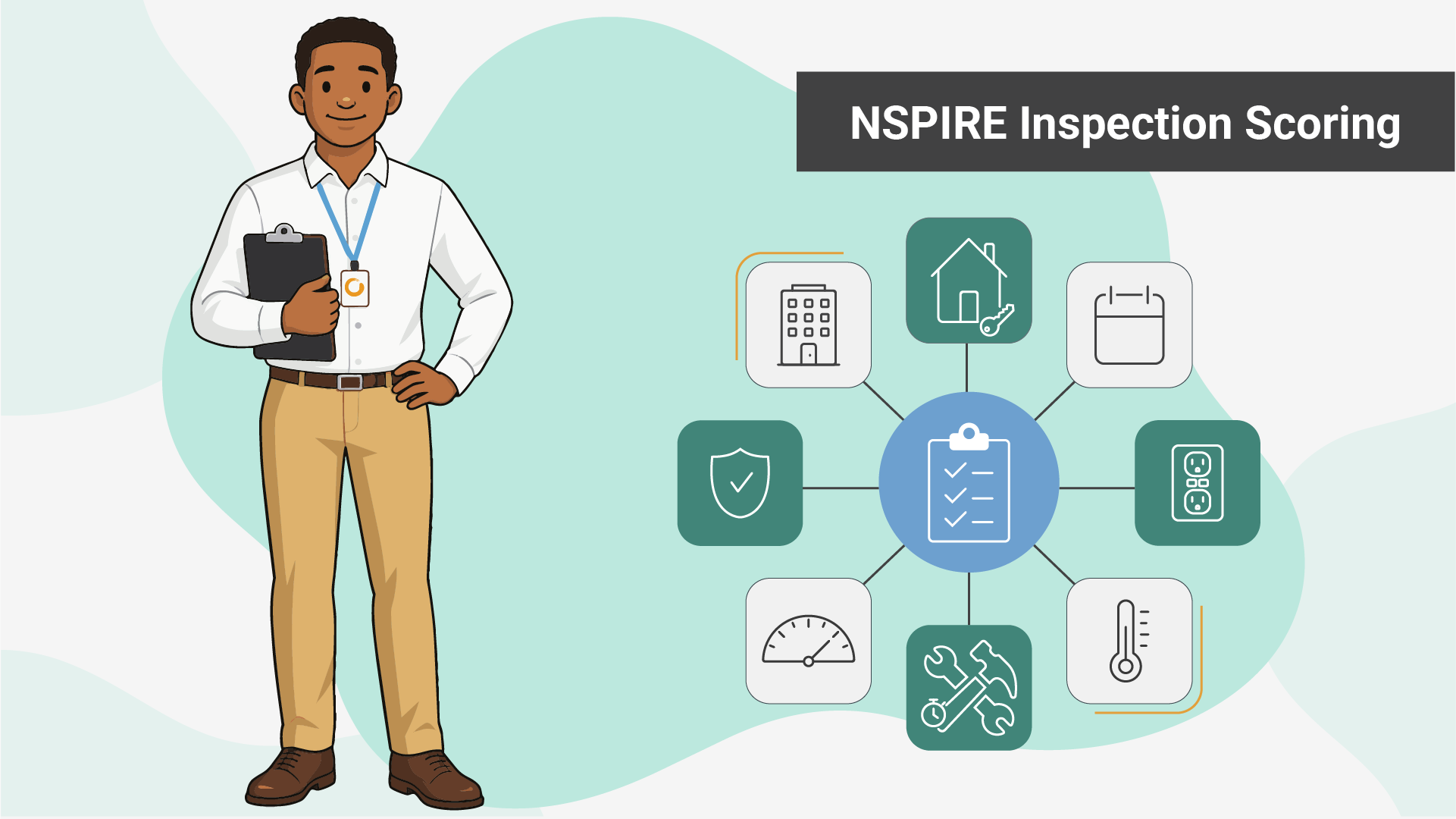
What is NSPIRE?
NSPIRE, the National Standards for the Physical Inspection of Real Estate, is the US Department of Housing and Urban Development's (HUD's) single inspection standard for HUD-assisted housing. It replaced the Uniform Physical Condition Standards (UPCS) that the Real Estate Assessment Center (REAC) used to inspect public housing and multifamily properties. It also replaces Housing Quality Standards (HQS) in voucher programs, which must switch no later than February 1, 2027.
For public housing agencies (PHAs), two dates matter most right now. HUD began scoring NSPIRE's new affirmative requirements in public housing and multifamily inspections on October 1, 2026. And voucher programs have until February 1, 2027, to leave HQS behind.
This guide covers what NSPIRE is, why HUD made the change, who it applies to and when, what the standards require, how scoring works, how often inspections happen, and how to prepare your agency.
| Program | NSPIRE date | Source |
|---|---|---|
| Public housing | In effect July 1, 2023 | NSPIRE final rule |
| Multifamily housing | In effect October 1, 2023 | NSPIRE final rule |
| Public housing and multifamily: affirmative requirements scored | October 1, 2026 | Notice PIH 2025-27 |
| Housing Choice Voucher, Project-Based Voucher, and Moderate Rehabilitation | No later than February 1, 2027 | Notice PIH 2026-18 |
What does NSPIRE stand for?
NSPIRE stands for the National Standards for the Physical Inspection of Real Estate. HUD published the final rule on May 11, 2023.
Before NSPIRE, HUD-assisted housing was inspected under different standards depending on the program. REAC inspected public housing and multifamily properties under UPCS, and PHAs inspected voucher units under HQS. The final rule consolidates and aligns inspection standards across fourteen sections of HUD's regulations into one framework.
What is an NSPIRE inspection?
An NSPIRE inspection is a physical inspection that checks whether HUD-assisted housing is "functionally adequate, operable, and free of health and safety hazards," as 24 CFR 5.703 requires. Inspectors record each deficiency, classify it by severity, and note where on the property they found it.
The three inspectable areas
NSPIRE divides a property into three inspectable areas:
Unit: the interior of the dwelling where the resident lives.
Inside: common areas and building systems inside the building but outside any unit, such as a laundry room or fitness room.
Outside: the site, the building exterior, and systems outside the building, such as playgrounds, sidewalks, and air-conditioning units.
HUD says the three areas let inspectors cite a deficiency based on where they are standing, which removes guesswork about where a problem belongs.
Who does the inspection?
Public housing and multifamily properties: REAC conducts the inspections and issues a score.
Voucher units: your agency's own inspectors inspect Housing Choice Voucher (HCV), Project-Based Voucher (PBV), and Moderate Rehabilitation units. These inspections are often called NSPIRE-V.
Why did HUD change to NSPIRE?
HUD built NSPIRE around one idea: the condition of the home matters more than how the property looks on inspection day.
Health and safety over appearance. HUD's NSPIRE overview says the model prioritizes health, safety, and functional defects over appearance, so inspections better reflect a property's true condition. For voucher programs, HUD says the standards "remove subjective opinions about general health and safety, housekeeping, and cosmetics/aesthetics" (PIH 2026-18).
One framework instead of several. Consolidating UPCS, HQS, and other program rules gives every covered program a common set of inspection standards.
Year-round maintenance. HUD says the model supports maintaining properties all year, not just preparing for inspection day.
More consistent data. HUD's stated goals include more consistent inspections and more reliable data for managing its portfolio.
Who NSPIRE applies to, and when
Public housing and multifamily
NSPIRE took effect for public housing on July 1, 2023, and for multifamily housing on October 1, 2023. HUD's Notice PIH 2025-27 delayed scoring of the new affirmative requirements until October 1, 2026. During the delay, HUD still cited these deficiencies and required them to be corrected on schedule. They just didn't count against the score.
Housing Choice Voucher, PBV, and Moderate Rehabilitation
Voucher programs must move from HQS to NSPIRE no later than February 1, 2027, under Notice PIH 2026-18. Each PHA chooses its own implementation date up to that deadline, and HUD encourages agencies to switch sooner. Once your agency switches, forms HUD-52580 and HUD-52580-A no longer apply.
If your inspectors still work from an HQS form, our guide to the HQS inspection checklist and NSPIRE-V walks through what flips and what stays the same.
Community Planning and Development programs
NSPIRE also reaches Community Planning and Development (CPD) programs, such as HOME and the Housing Trust Fund, on their own timelines. HUD tracks those dates on its NSPIRE Official Notices page.
NSPIRE standards and inspection requirements
The NSPIRE standards list every inspectable item, the deficiencies an inspector can cite for it, and the severity of each.
Deficiency severity levels
Every deficiency falls into one of four severity levels: life-threatening, severe, moderate, or low. Severity sets the correction deadline and, for scored inspections, how many points come off.
Correction timelines
Correction deadlines depend on the program.
| Severity | Public housing and multifamily | Voucher units |
|---|---|---|
| Life-threatening | 24 hours | 24 hours; unit fails |
| Severe | 24 hours | 30 days; unit fails |
| Moderate | 30 days | 30 days; unit fails |
| Low | 60 days | Noted; unit passes |
Public housing and multifamily timelines come from 24 CFR 5.711, which lets HUD set different periods through published standards, notices, or approved variations. Voucher timelines come from PIH 2026-18, which also states that low deficiencies still result in a passed inspection.
Affirmative requirements
NSPIRE doesn't only list conditions to avoid. It also sets affirmative requirements, things a property must have. PIH 2025-27 lists the deficiencies HUD began scoring on October 1, 2026:
Fire-labeled doors: all defects, in all locations.
Ground-fault or arc-fault circuit interrupter (GFCI or AFCI) protection: an unprotected outlet within six feet of a water source.
Guardrails: all defects, in all locations.
Heat: from October through March, heat that works but only reaches 64 to 67.9°F, or heat that doesn't work or a unit below 64°F. From April through September, a permanent heat source that is damaged, inoperable, missing, or not installed.
Interior lighting: no permanently installed light fixture in a kitchen or bathroom.
Minimum electrical and lighting: a habitable room without at least two working outlets, or one working outlet and one permanently installed light fixture.
If these items haven't been part of your preventive maintenance, start there. Our guide to public housing maintenance software covers how agencies track work orders and inspection follow-up.
Annual self-inspections
Under 24 CFR 5.707, PHAs and owners of HUD housing must self-inspect their properties, including all units, every year. They must keep the results for three years and provide them to HUD on request. Owners in the HCV, PBV, and Moderate Rehabilitation programs are exempt.
Where to find the standards
NSPIRE Standards: every inspectable item, deficiency, and severity level.
NSPIRE Inspection Protocol Guide: how REAC inspections are conducted. HUD notes that it doesn't apply to HCV inspections.
NSPIRE HCV/PBV Inspection Checklist: HUD's free, optional checklist for voucher inspections.
How NSPIRE scoring works
Scoring applies to public housing and multifamily properties. HUD's NSPIRE Scoring Notice converts the deficiencies an inspector observes into a score from 0 to 100.
The 0 to 100 score
Each deficiency takes points off based on two things: its severity and the inspectable area where it was found. HUD weights deficiencies inside units more heavily than those elsewhere, and a life-threatening deficiency in a unit carries the largest deduction (HUD announcement, July 2023).
What is a passing NSPIRE score?
A passing NSPIRE score is 60 or higher. Under the Scoring Notice, any score under 60 fails. Two more thresholds apply:
Unit threshold: if 30 points or more are deducted for deficiencies inside units, the property fails the inspection, even if its total score is 60 or higher.
Enforcement referral: a property that scores 30 or less is automatically referred to HUD's Departmental Enforcement Center.
A failing score also creates more work. Under 24 CFR 5.711, when a property scores below 60, the PHA or owner must survey the entire project, including all units and both inside and outside areas, and submit the results to HUD electronically.
Requesting a technical review
If you believe an inspection contains an error, you can request a technical review. REAC must receive the request no later than the forty-fifth calendar day after HUD provides the inspection report (Notice PIH 2023-16).
Estimate your score
HUD publishes an NSPIRE Score Calculator in Excel. Enter the types and locations of deficiencies to estimate a score. HUD notes that many factors affect an actual score, so treat the result as an estimate.
Voucher inspections aren't scored
Voucher inspections stay pass/fail. In HUD's words, "Voucher program inspections are not numerically scored" (PIH 2026-18).
In September 2026, HUD requested comment on revisions to the Scoring Notice: a sample-size correction, corrections to a worked example, and the October 1, 2026, compliance date for affirmative requirements. The notice states that it doesn't revise inspection frequencies.
How often do NSPIRE inspections happen?
For public housing and multifamily properties, the last inspection score generally sets how soon HUD inspects again, under 24 CFR 5.705:
| Last inspection score | Next HUD inspection |
|---|---|
| 90 or higher | Every 3 years |
| 80 to 89 | Every 2 years |
| Below 80 | Every year |
HUD times each inspection within three months before or after the anniversary of the previous one. Small PHAs and small rural PHAs follow their own cycles under 24 CFR part 902. Your agency's annual self-inspection happens on top of this schedule.
For HCV units, 24 CFR 982.405 requires the PHA to inspect a unit before the initial lease term and at least every two years during assisted occupancy. Small rural PHAs inspect once every three years.
How to prepare your agency
Confirm your NSPIRE-V date with HUD. PIH 2026-18 asked PHAs to email their voucher implementation date by September 30, 2026. If you haven't, send it now. The date can't be later than February 1, 2027.
Run a full self-inspection against today's standards. Use HUD's NSPIRE Standards, not an old UPCS or HQS form.
Check the affirmative requirements first. Fire-labeled doors, GFCI or AFCI protection near water, heat, guardrails, and kitchen and bathroom lighting now count against the score.
Retrain inspectors and maintenance staff. Everyone who touches an inspection should know the four severity levels and their correction deadlines. HUD's NSPIRE webinars are a free place to start, and our post on getting real value from HUD resources shows how to turn them into know-how for your team.
Update your Administrative Plan and notify owners and families. Voucher agencies should document their inspection standards and procedures, then tell every owner and family what changes and when.
Choose your inspection tool. HUD says it is "no longer creating an application for PHAs to use" (PIH 2026-18), so your agency needs its own way to record inspections and track 24-hour and 30-day corrections.
NSPIRE is one of several HUD changes landing at once. For a simple system to stay ahead of all of them, see how to keep up with constant HUD regulation changes.
Keep inspections and corrections in one place
Kanso runs NSPIRE-V inspections alongside the rest of your HUD compliance work. See how Kanso's HUD compliance software helps your team work from one set of rules.

Frequently asked questions
-
National Standards for the Physical Inspection of Real Estate. It's HUD's single inspection standard for HUD-assisted housing, replacing UPCS and HQS.
-
A score of 60 or higher. A property also fails if 30 points or more are deducted for deficiencies inside units, even when its total score is 60 or higher.
-
For most public housing and multifamily properties, every three years with a score of 90 or higher, every two years with a score of 80 to 89, and every year below 80. HCV units are inspected at least every two years, or every three years at small rural PHAs.
-
No later than February 1, 2027, for the HCV, PBV, and Moderate Rehabilitation programs. Agencies can switch earlier, and HUD encourages it.
-
No. Voucher inspections are pass/fail. Low deficiencies are noted, but the unit still passes.
This page is general information and does not replace HUD regulations, notices, or guidance. Confirm requirements against the current HUD notice before acting
