
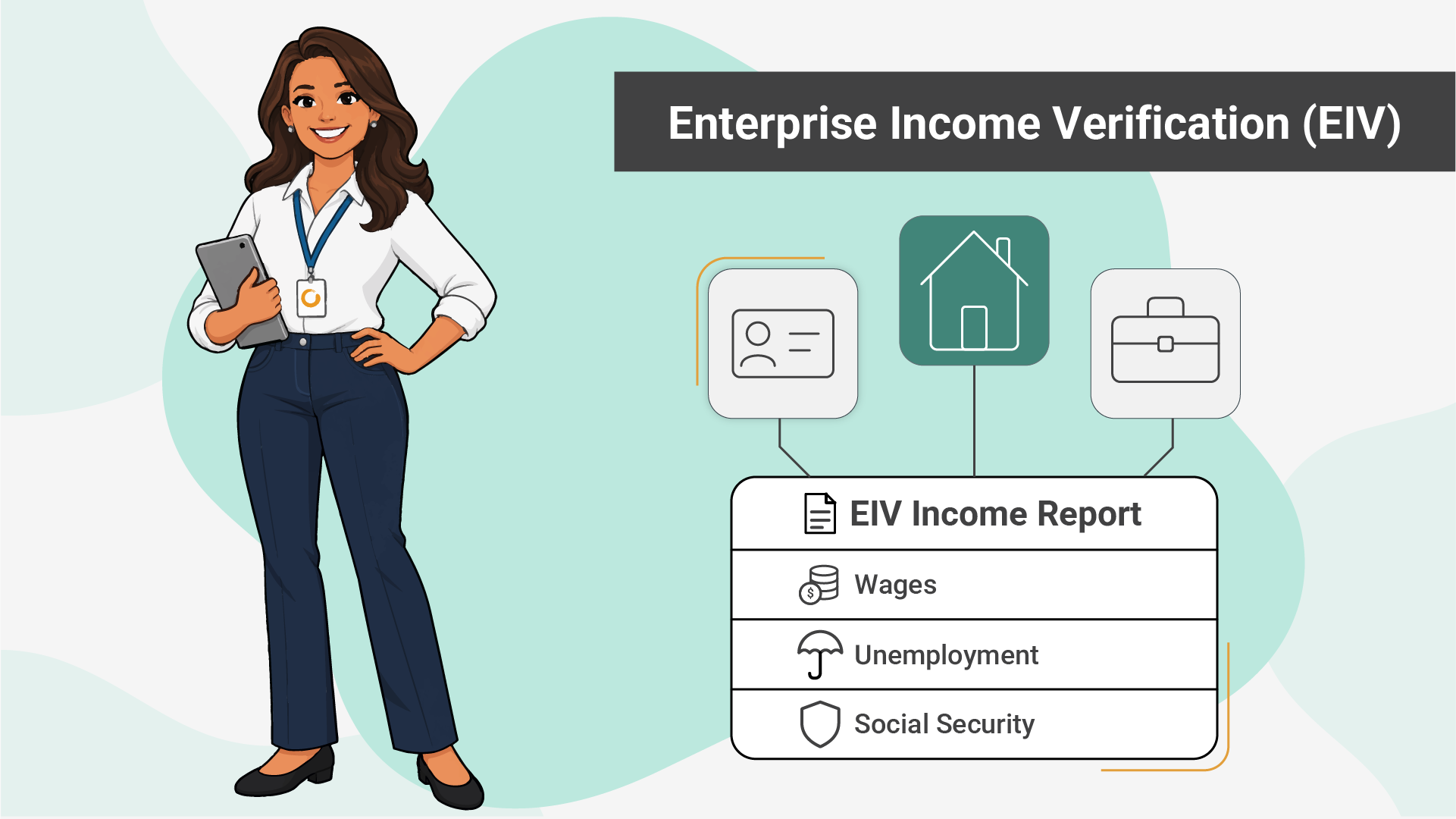
Enterprise Income Verification (EIV) is the US Department of Housing and Urban Development's (HUD's) system that gives public housing agencies (PHAs) employment, wage, unemployment, and Social Security data on the households they assist. The data comes from the Social Security Administration (SSA) and the Department of Health and Human Services' (HHS's) National Directory of New Hires (NDNH).
For most PHAs, EIV is about to work a little differently. HUD will enforce sections 102 and 104 of the Housing Opportunity Through Modernization Act (HOTMA) starting January 1, 2027, under Notice PIH 2026-15, and HOTMA changes when EIV is required. Whatever your timeline, your staff and your HUD compliance software should follow the same rules. Here's what EIV is, which reports to run, and what to tighten up before January.
What the EIV system does
EIV matches the people on your HUD-50058 records against federal data and returns two kinds of information:
Income data: Wages, unemployment compensation, and Social Security and Supplemental Security Income (SSI) benefits for each household member.
Flags: Reports that point to possible problems, such as identity mismatches, deceased tenants, or families receiving assistance in more than one place.
HUD ranks EIV at the top of its verification hierarchy. In Table J2 of Notice PIH 2023-27, Revision 3, upfront income verification through EIV is Level 6, the highest level. EIV can be the sole verification of Social Security income. Below it sit other upfront verification tools, written third-party verification (or "EIV plus self-certification" when the family agrees with the EIV figures), third-party verification forms, oral verification, and self-certification as a last resort.
EIV isn't only for PHAs. Under 24 CFR 5.233, owners in HUD's project-based Section 8 and other Multifamily programs must use it too. This guide covers the PHA side.
Is EIV required? What HOTMA changes
HUD has required PHAs to use EIV in its entirety since January 31, 2010, the effective date of the final rule that created 24 CFR 5.233. HOTMA keeps EIV in place but changes where it's required, as section J.3 of PIH 2023-27 explains:
Annual and streamlined reexaminations: EIV is still required. Pull the EIV Income Report at every annual reexamination, within 120 days before its effective date. The exception is when you verify income with a Safe Harbor determination from another means-tested federal program.
Interim reexaminations: EIV is no longer required, but you may keep using it. Either way, put your choice in your Administrative Plan or Admissions and Continued Occupancy Policy (ACOP) and apply it to every household. HUD's HOTMA FAQs add that a policy to stop running EIV at interims must be adopted by your board of commissioners first.
Everything else: HUD still requires PHAs to use EIV in its entirety at all other times, including its required reports.
Penalties: Under 24 CFR 5.233(b), failing to use EIV in its entirety can lead to sanctions, disallowed costs, or both.
Timing: HUD enforces HOTMA sections 102 and 104 on January 1, 2027. Moving to Work agencies and agencies that use only HUD's Family Reporting Software will get their enforcement dates once HUD finishes system changes. Agencies that start annual reexaminations 120 days out were expected to begin using HOTMA verification policies in September 2026.
If HUD rule changes feel constant, they are. Truth #1 in our executive director series covers how to keep up.
The EIV reports to know
Table J1 of PIH 2023-27 sets how often PHAs must use each EIV report. Here are the ones most PHAs work with:
| Report | What it shows | When PHAs use it |
|---|---|---|
| Income Report | Wage, unemployment, and Social Security data for each household member | Every annual reexamination, unless you used Safe Harbor. For new admissions, within 120 days after move-in data is sent to HUD. Optional at interims. |
| Income Validation Tool (IVT) | Possible unreported wage, unemployment, and Social Security income | Every annual reexamination, unless you used Safe Harbor at the last one |
| Existing Tenant Search | Applicants who may be receiving assistance somewhere else | When processing an applicant for admission |
| Debts Owed to PHAs and Terminations | Former tenants who left owing a PHA or had a voucher terminated for cause | When processing an applicant for admission, and to record debts or terminations when a family leaves |
| Identity Verification | Tenants who failed SSA verification and EIV prescreening | Monthly |
| Failed Verification | Tenants whose name, date of birth, or Social Security number doesn't match SSA records | Monthly |
| Deceased Tenants | Tenants SSA reports as deceased | At least monthly. Voucher programs check it before each month's Housing Assistance Payments (HAP). |
| Multiple Subsidy | Tenants who may be receiving assistance at more than one location | At least quarterly |
| New Hires | New employment in the last six months | At annual reexaminations unless you used Safe Harbor, and quarterly after an interim decrease if your policy requires interims for later increases |
One report has a newer rule. Table J1 lists Deceased Tenants as at least quarterly, but Notice PIH 2026-11, issued two weeks later, now requires PHAs to run it at least once a month.
Your Administrative Plan or ACOP sets when you check reports HUD leaves to your discretion, such as No Income Reported by HHS or SSA.
One limit to remember: EIV doesn't verify an applicant's income. Before admission, rely on other documents, such as pay stubs and benefit award letters.
The IVT replaced the older Income Discrepancy Report. HUD made the switch to cut false positives, which it estimated at about half of all discrepancies flagged by the old report, according to a Federal Register notice. HUD also plans to update the IVT's discrepancy logic to match HOTMA. Until HUD says the new reports are ready, PHAs aren't required to investigate discrepancies the IVT flags.
The newest EIV report: EIV-SAVE
On January 22, 2026, HUD added the EIV-SAVE Tenant Matching Report. It compares the citizenship and immigration status on your HUD-50058 records with data from US Citizenship and Immigration Services' Systematic Alien Verification for Entitlements (SAVE) system, and it lists people whose status needs to be confirmed. You'll find it as an option under the IVT report.
What HUD required: In its announcement letter, HUD gave PHAs 30 days to review the report, confirm each person's status is reported correctly on the HUD-50058, and correct any errors. HUD later refreshed the report with April 2026 data and required executive directors to attest, by August 3, 2026, that they had reviewed the people it lists.
What a listing means: Appearing on the report doesn't automatically make someone ineligible. HUD's EIV-SAVE FAQs say PHAs can't use the report's SAVE response alone to decide eligibility. They must run their own verification through SAVE.
Keep your records: The report doesn't refresh automatically, so people stay on it until HUD updates it. PHAs don't send their review results to HUD, but HUD may ask for documentation of how each status was verified.
Enforcement: HUD says it will monitor compliance, and PHAs that don't use EIV reports as required may face sanctions.
How to handle an income discrepancy
The regulation at 24 CFR 5.236 sets the rules when EIV shows an income source the family didn't disclose, or income that differs substantially from what the family reported:
Verify independently. Request information from the undisclosed employer or income source, or verify directly with the family.
Follow HUD's verification hierarchy. Under Table J2 of PIH 2023-27, use written third-party verification when a tenant disputes the employment and income data in EIV.
Notify the family in writing of any adverse finding.
Let the family contest it the same way they could contest other eligibility findings.
Wait out the notice period. You can't terminate, deny, suspend, or reduce assistance until any required notice period ends.
Security, access, and record retention
EIV holds sensitive federal data, so access is tightly controlled:
User access: Each EIV user completes Form HUD-52676, the EIV System User Access Authorization Form and Rules of Behavior and User Agreement. The executive director or a designee approves user roles. A new form is required for new users, role changes, and reinstated or terminated access, according to HUD's EIV FAQs.
Training: The same FAQs require PHA EIV users to complete the Cyber Awareness Challenge training or a comparable course.
Disclosure limits: Federal law restricts how income data from SSA and the IRS can be shared (24 CFR 5.236(b)(6)).
Retention: Under 24 CFR 908.101, keep at least the last three years of HUD-50058s and supporting documentation during the lease, and for at least three years after the end of participation.
Most of these answers already live in HUD's own notices. Truth #3 walks through how to find and use them.
Common EIV mistakes to avoid
Skipping the monthly and quarterly reports between annual reexaminations.
Acting on EIV data too soon, before independent verification and written notice to the family.
Lapsed access forms or training when staff change roles or leave.
Changing your interim EIV practice without updating your Administrative Plan or ACOP.
Where your software fits
EIV gives you the data. Staying compliant means acting on it on time, every time. Good HUD compliance software helps you track reexamination dates, document how each discrepancy was resolved, and keep tenant files ready for an audit.
See how Kanso's HUD compliance software keeps reexaminations, compliance tracking, and reporting in one place, so your team works from one set of rules.
Frequently asked questions
-
Enterprise Income Verification (EIV) is HUD's system that gives PHAs employment, wage, unemployment, and Social Security data on assisted households. The data comes from the Social Security Administration and the National Directory of New Hires.
-
An EIV report is a HUD report that PHAs pull from the EIV system. The most common is the Income Report, which shows wage, unemployment, and Social Security data for each household member. Other reports flag identity mismatches, deceased tenants, households receiving assistance in more than one place, and citizenship or immigration status that needs to be confirmed.
-
No. PHAs must rely on other documents, such as pay stubs and benefit award letters, to verify an applicant's income before admission. After a new admission, PHAs check the family's income in EIV within 120 days, unless they used Safe Harbor documentation.
-
No. Under HOTMA, EIV is optional at interim reexaminations. PHAs must state their choice in the Administrative Plan or ACOP and apply it to all households. EIV is still required at annual and streamlined reexaminations, unless the PHA uses a Safe Harbor income determination.
-
Under 24 CFR 908.101, keep at least the last three years of HUD-50058s and supporting documentation during the lease, and for at least three years after the family's end of participation.
This post is general information and does not replace HUD regulations, notices, or guidance. Confirm requirements against the current HUD notice before acting.
